Happening Now
Models Show Mardi Gras’ Untapped Potential
March 6, 2026
by Jim Mathews / President & CEO
By now, everyone knows Amtrak’s new Mardi Gras Gulf Coast service between New Orleans and Mobile has been wildly successful, beating a full year’s ridership predictions in just a few months. Like the Borealis a year earlier between Minneapolis/St. Paul and Chicago, the huge demand to get aboard the Mardi Gras is proof that a great service with a convenient schedule and great timekeeping will always be a winner.
Gulf Coast communities served by the Mardi Gras are already seeing benefits, as curious leisure travelers hop off in wonderful places like Bay St. Louis or Pascagoula, checking out uncrowded beaches and cool little art studios. And a lot of people are discovering that Mobile is about a lot more than just jumping on a cruise ship. As for NFL gameday when the Saints are at home? Amtrak has had to add an extra coach on Football Sundays.
But recent work by the Association’s data team suggests that as great a success story as the Mardi Gras is today, it could be even better. Our modeling already told us that, based on the demographics and economic characteristics of the served communities, the Mardi Gras was going to outperform expectations. And that’s what it did, blowing past its annual ridership projections in just the first six months of service. But our models suggest that the Mardi Gras could carry even more passengers and provide even greater economic benefit for entire Gulf Coast region if Amtrak could add more coaches to the trains.
Before the Mardi Gras Service kicked off last August, Amtrak predicted annual ridership of 71,000 passengers. Since entering service the Mardi Gras has been on track to far exceed that estimate, carrying 59,000 passengers by the end of calendar year 2025, reaching 70,500 by the end of January, and projected to carry 160,000 passengers in Fiscal 2026 if it maintains consistent average monthly ridership.
Accounting for the capacity of the trains operating the service, monthly ridership is consistent with the total number of seats available on two- to three-car trains at between 85 percent and 90 percent load factor. But we see enough demand for perhaps even a five-coach train every day.
Rail Passengers’ model predicts that at the current frequency of two daily trains in each direction, 170,424 passengers would ride the Mardi Gras every year, or an average of 14,201 passengers per month. That latter figure is within five percent of actual Mardi Gras ridership during its busiest month to date, October 2025.
Now, Rail Passengers’ demographic analysis predicts a potential addressable market of 382,335 passengers per year, or an average of 31,861 passengers per month. That’s obviously well beyond actual reported monthly ridership, but it’s also well beyond the seat capacity of the current two- to three-car Mardi Gras consists. To capture that total addressable market, Amtrak would need to lengthen both daily Mardi Gras consists to five coaches.
We were recently asked to take a closer look at this Gulf Coast service, with an eye toward understanding its future potential. Taking our two estimates together, Rail Passengers’ analysis confirmed that not only can we expect more great results from the Mardi Gras, but further revealed where along the Mardi Gras route there may be unmet travel demand.
Our ridership estimates at the two terminal stations, New Orleans and Mobile, represent between 85 and 90 percent of the predicted addressable market. At intermediate stations, however, estimated ridership is less than 30 percent of that potential market -- and as low as 14 percent in Bay St. Louis.
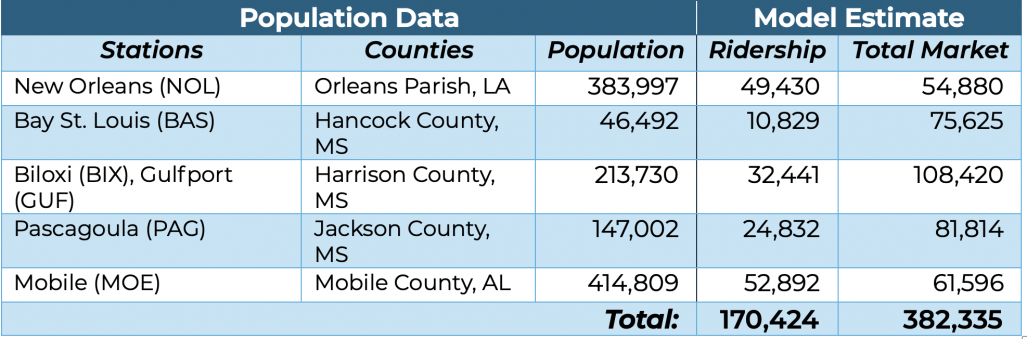
That’s consistent with what we’ve found looking at many other stations across the Amtrak network, where small-to-midsize towns can attract many times more annual riders than their local resident populations. Therefore, even though our ridership estimate for the whole route suggests there may be adequate capacity on the current two- to three-car trains to meet current demand, we think additional coaches would be most effective at capturing more potential riders traveling to or from intermediate stops along the route.
If Amtrak were able to expand capacity on the Mardi Gras to capture our estimated total addressable market, then the potential economic benefit would be impressive: $29.71 million in new spending by passengers, 426 new jobs, $7.61 million in new tax revenue, and $49.88 million in total growth for the region every year the service operates.
Dr. John Christoph, Council member, former Tempe, Ariz., transportation commissioner, and our Chief Data Scientist here at the Association, was excited by the results and what the newly expanded data team has been able to produce.
“This report on the Mardi Gras represents the first iteration of our new capability to predict how the frequency and capacity of a train service will impact how many passengers ride it,” he told me. “For those of y'all who've seen the work we presented in San Antonio last Fall, we've come a long way since then, and we plan to continue apace at expanding what our research and analysis tools can do.”
"I wish to extend my appreciation to members of the Rail Passengers Association for their steadfast advocacy to protect not only the Southwest Chief, but all rail transportation which plays such an important role in our economy and local communities. I look forward to continuing this close partnership, both with America’s rail passengers and our bipartisan group of senators, to ensure a bright future for the Southwest Chief route."
Senator Jerry Moran (R-KS)
April 2, 2019, on receiving the Association's Golden Spike Award for his work to protect the Southwest Chief
Comments