Happening Now
Highlights from Senate Report on Rail Investment Cliff
May 15, 2026
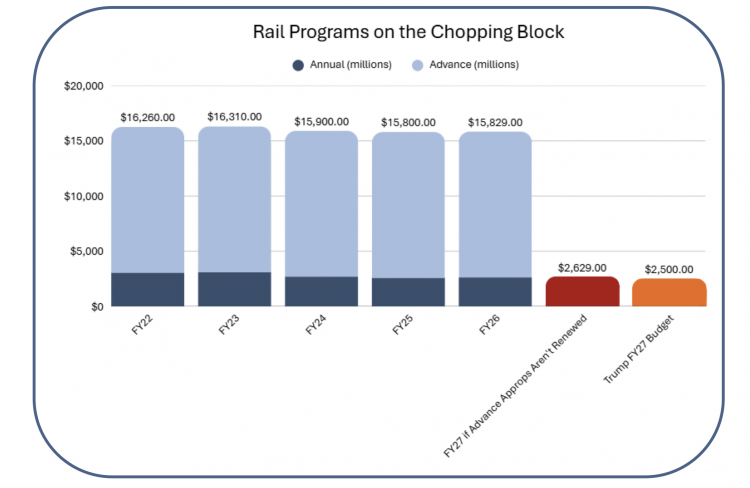
Democratic Senators released “American Rail on the Chopping Block”, a report that breaks down federal investment in rail projects and unmet grant needs.
By Sean Jeans-Gail | VP of Gov’t Affairs
--
Rail Passengers Association joined earlier this week with a coalition of Senate Democrats who announced they are working to extend the guaranteed funding for rail programs—both in the current annual budget process and the next multi-year surface transportation reauthorization.
As part of that effort, the coalition of Senators issued a report titled “American Rail on the Chopping Block”, which lists the number of rail projects funded by the Infrastructure Investment and Jobs Act (IIJA), while attempting to with the size of the investment needs that remain.
The document is worth reading in its entirety, but Rail Passengers is sharing a few highlights from the report.
Historic Investment in Rail
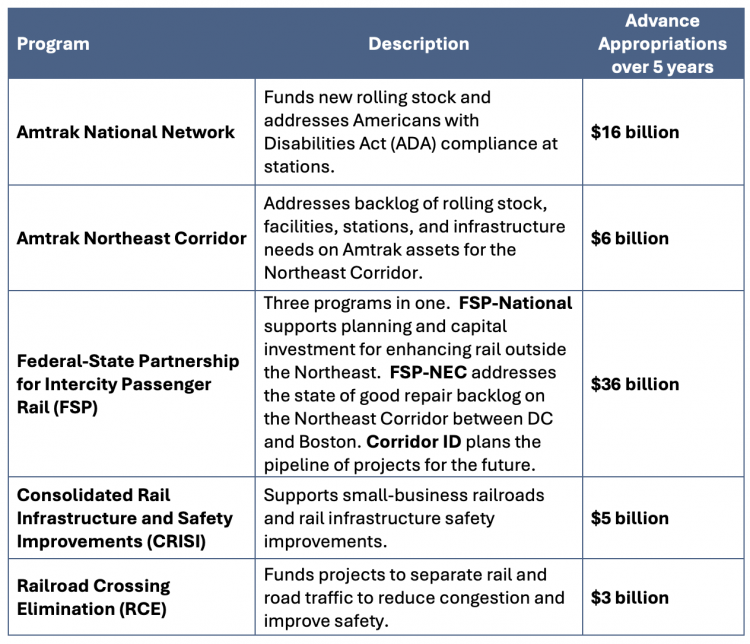
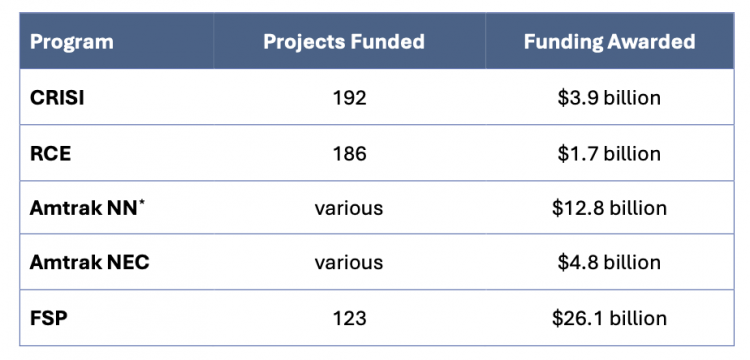
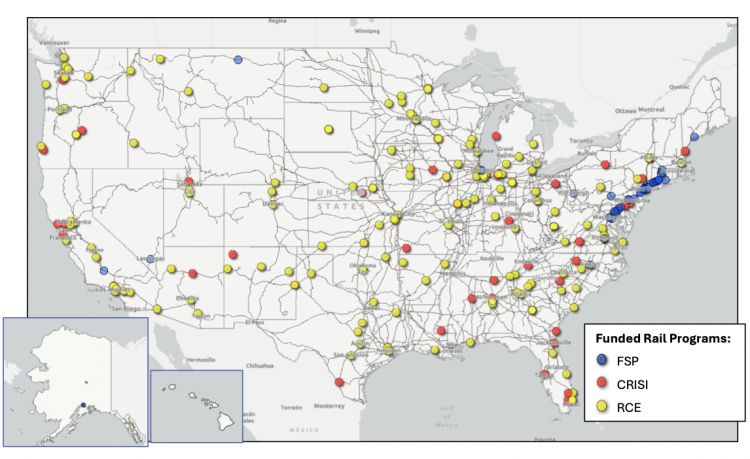
The report details over 500 rail projects in 49 states that received $49 billion in IIJA funding. It also includes an interesting state-by-state breakdown of rail projects in Appendix B (unsurprisingly, NEC states were the biggest winners in these first rounds of funding).
Untapped Expansion Potential
The report also outlines how many projects are still in the pipeline, and will need funding from the IIJA’s successor legislation:
- The FRA’s Long Distance Service Study showed “it would cost approximately $52.5 billion to expand current long distance Amtrak service. FRA’s proposal would add 23,000 route-miles of passenger rail to bring high-quality service to rural communities across the country—serving an additional 39 million Americans and increasing rural community access to passenger rail by 43 percent.”
- States and localities are using the Corridor ID program to advance 69 corridors across 44 states for new and/or improved passenger rail service.
- The Northeast Corridor Commission estimates the need for Northeast Corridor (NEC) infrastructure for FY26-30 to be $34.3 billion for 20+ projects and programs.
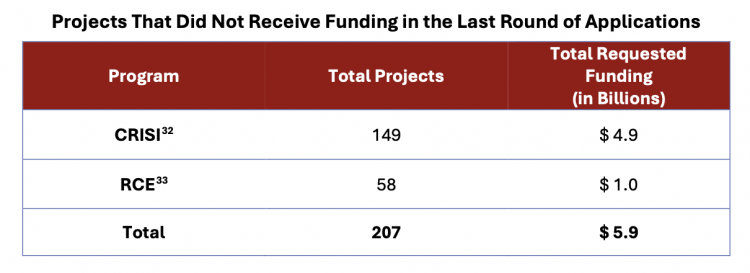
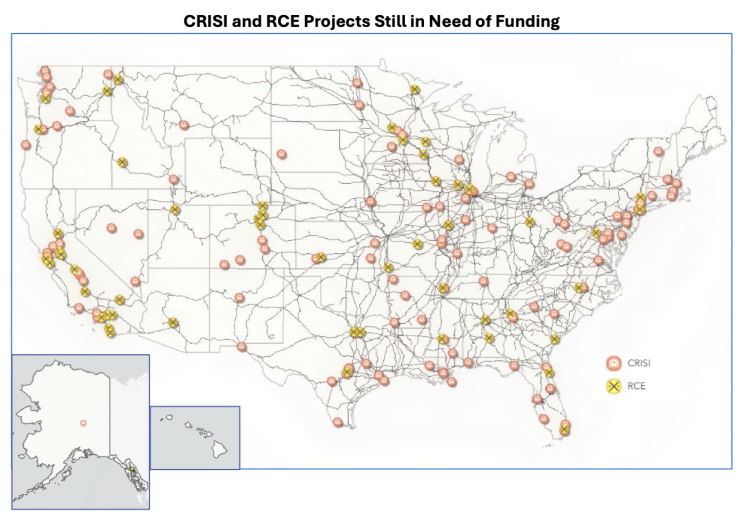
- More than 200 projects that applied for funding during the last round of applications for CRISI and RCE programs were not selected, leaving a nearly $6 billion gap in funding for rail projects from these two programs alone.
Investment Cliff Will Cost Americans
The report includes research from several outside organizations on the cost of the transportation status quo for individual Americans:
- American families will incur $700 in additional costs each year due to the impacts of underinvesting in U.S. infrastructure.
- Underinvestment makes it harder for American-grown and -manufactured goods to reach international consumers, decreasing exports by $45 billion by 2033, negatively impacting our trade deficit and resulting in 237,000 lost jobs.
- The average American sits in traffic 63 hours each year, costing $269 billion in lost time.
Charting a Path Forward
Finally, the report outlines three overarching goals for the upcoming surface transportation reauthorization:
- Renew Advance Appropriations: “Without adequate funding, multimodal bottlenecks will persist, limiting the benefits of highway investments, and putting rail competitors that can move freight cheaper at a disadvantage. The solution is to sustain long-term investments in our nation’s multimodal rail system to reduce costs for businesses and consumers.”
- Preserve Rail Programs: “America has underinvested in many parts of our rail system. Given the national importance of infrastructure, and the public demand for world-class passenger rail options, we cannot risk letting rail infrastructure get kicked to the curb.”
- Cut Red Tape: “Discretionary grants allow the federal government to make strategic investments in our national transportation system. However, lengthy applications require expensive consultants to draft, grant agreements take too long to get signed after awards are made, and money takes too long to get into the hands of local governments so they can start construction. Congress should cut through the red tape by simplifying the discretionary grant process to make federal investment more efficient and effective.”
Rail Passengers has included specific proposals around many of these in our reauthorization proposal, which you can find at RailPassengers.org/Blueprint.
"On behalf of Amtrak’s onboard service staff, I want to thank the Rail Passengers Association for honoring their hard work with this award. The past couple years have indeed been difficult for Amtrak onboard service staff – coping with furloughs and job insecurity, adapting to changing protocols and services, not to mention the unfortunate events such as a tragic derailment and a fatal shooting. Nevertheless, our dedicated members at Amtrak have handled these hurdles with the care, attention and diligence for which they’re known. We thank Rail Passengers for their acknowledgement of our members’ hard work and, as always, look forward to seeing you on the rails."
Arthur Maratea, TCU/IAM National President
December 21, 2021, on the Association awarding its 2021 Golden Spike Award to the Frontline Amtrak Employees.
Comments